
UAE corporate tax collections have risen sharply, reaching AED 46.52 billion for 2025 tax periods. But what does this mean for businesses operating in the Emirates, and are you confident your company is meeting its tax obligations?
The UAE's corporate tax system is becoming an established part of doing business in the country.
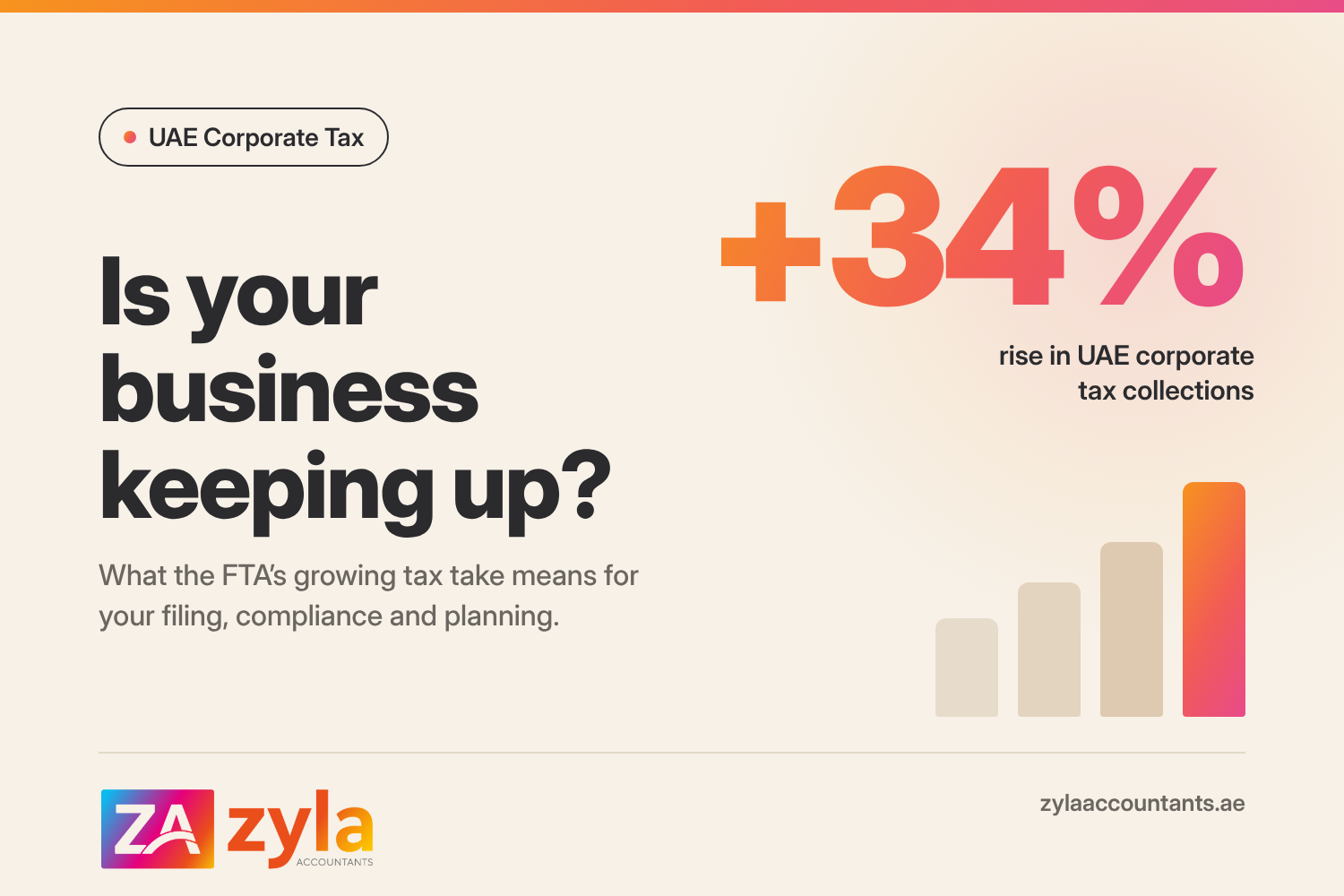
According to figures announced by the Federal Tax Authority (FTA) in November 2026, corporate tax collections for 2025 tax periods increased by approximately 34% compared with 2024 tax periods.
It's a significant development for the UAE's tax landscape, but there's another figure that deserves the attention of business owners.
The FTA also reported an on-time corporate tax filing compliance rate of approximately 91% in 2026.
That means not every business required to file is meeting its deadlines.
For UAE companies, entrepreneurs and growing businesses, the message is clear: corporate tax compliance needs to be part of everyday financial management, not something left until the filing deadline approaches.
UAE Corporate Tax Is Now a Business Priority
The numbers tell the story.
Source: FTA figures reported November 2026. Collections relate to 2025 tax periods.
The introduction of federal corporate tax marked a major change for businesses operating in the UAE.
For many years, the country's tax environment was one of its most attractive features. While the UAE continues to offer a competitive business environment, companies now need to understand and manage their corporate tax responsibilities.
Under the standard UAE corporate tax framework, taxable income is generally subject to:
0% corporate tax on taxable income up to AED 375,000.
9% corporate tax on taxable income exceeding AED 375,000.
Special rules, exemptions and reliefs may apply depending on the business and its circumstances.
Importantly, businesses should not assume that earning less than AED 375,000 automatically removes their registration or filing obligations.
Even where no corporate tax is payable, a business may still need to register, maintain records and submit a corporate tax return.
For business owners who are already juggling customers, staff, suppliers and cash flow, these additional responsibilities can easily be overlooked.
Why the 34% Increase Matters
An increase in corporate tax collections does not necessarily mean tax rates are rising.
Instead, the latest figures highlight the growing financial significance of corporate tax within the UAE.
For businesses, this is an important reminder that corporate tax is no longer a new concept that can be dealt with later.
It requires proper planning, accurate accounting records and an understanding of the rules that apply to your organisation.
And while the FTA's reported filing compliance rate is encouraging, businesses that miss deadlines can still face financial and administrative consequences.
The real question isn't simply whether your business owes corporate tax. It's whether your business is managing its obligations correctly.
Five Corporate Tax Checks Every UAE Business Should Make
1. Are You Registered for Corporate Tax?
Many UAE businesses are required to register for corporate tax, even where they expect to have no tax liability.
Registration requirements and deadlines depend on the business's circumstances.
If you're unsure whether your company should be registered, it's worth checking before a problem develops.
2. Do You Know Your Filing Deadline?
For most businesses, a corporate tax return must be submitted within nine months of the end of the relevant tax period.
For example, a business with a financial year ending on 31 December 2025 would generally need to file its corporate tax return and pay any tax due by 30 September 2026.
Different financial year ends mean different deadlines.
Missing the relevant deadline can result in administrative penalties.
3. Are Your Accounting Records Accurate?
Corporate tax calculations rely on reliable financial information.
Businesses should maintain appropriate records of income, expenditure, assets, liabilities and relevant transactions.
Incomplete bookkeeping can make it difficult to calculate taxable income correctly, identify allowable deductions and prepare accurate returns.
Good accounting records aren't just useful for tax compliance. They also give business owners better visibility over profitability and cash flow.
4. Are You Claiming the Reliefs You're Entitled To?
Depending on your circumstances, your business may qualify for corporate tax reliefs or exemptions.
For example, eligible resident businesses with revenue not exceeding AED 3 million may be able to elect Small Business Relief for qualifying tax periods ending on or before 31 December 2026, subject to the applicable conditions.
Qualifying Free Zone Persons may also benefit from a 0% rate on qualifying income where the relevant requirements are satisfied.
However, these arrangements are not automatic and the eligibility criteria matter.
Professional advice can help determine which provisions apply to your business.
5. Have You Planned for Your Tax Liability?
A profitable business can still experience cash flow difficulties if it hasn't planned for upcoming tax payments.
Corporate tax should form part of your wider financial planning.
Regular management accounts, accurate bookkeeping and forward-looking cash flow forecasts can help prevent unexpected liabilities from disrupting day-to-day operations.
The Cost of Getting Corporate Tax Wrong
Corporate tax mistakes can create problems beyond the tax return itself.
Late registration, missed filing deadlines, inaccurate information and inadequate record-keeping can expose businesses to administrative penalties.
They can also create unnecessary pressure on management teams and take valuable time away from running the business.
For growing SMEs, it's particularly important to establish good financial processes early.
As the business expands, the complexity of its transactions and reporting obligations may increase.
Having the right accounting support in place can make that growth easier to manage.
Corporate Tax Compliance Doesn't Have to Be Complicated
At Zyla Accountants, we understand that business owners want to focus on growing their companies, not spending hours interpreting tax legislation.
Our approach is hands-on, straightforward and designed around the needs of your business.
Whether you're an established UAE company, a growing SME or an entrepreneur navigating corporate tax for the first time, we can help you understand your obligations and keep your financial affairs organised.
Our UAE accounting support includes:
Corporate tax registration and compliance.
Corporate tax return preparation and filing.
Bookkeeping and financial reporting.
VAT compliance and reporting.
Ongoing accounting and business advice.
By taking a proactive approach to your finances, you can reduce the risk of avoidable mistakes and make better-informed business decisions.
Is Your UAE Business Ready for Its Next Corporate Tax Deadline?
The latest corporate tax collection figures are another reminder of how important tax compliance has become for businesses across the Emirates.
But staying compliant doesn't need to be overwhelming.
With accurate records, an understanding of your obligations and the right professional support, corporate tax can become a manageable part of running your business.
Not sure whether your UAE company is fully compliant?
Speak to Zyla Accountants about your corporate tax requirements, upcoming filing deadlines and ongoing accounting support.
Confident about your corporate tax position?
From filing deadlines to accurate financial records, Zyla helps UAE businesses stay organised and compliant. Get the support you need to move forward with confidence.
Speak to Zyla Accountants →Get in touch with Zyla Accountants today and let's make managing your business finances simpler.
This article provides general information based on UAE corporate tax rules and reported FTA figures as at November 2026. Individual obligations depend on business circumstances and applicable legislation. Professional advice should be obtained where appropriate.